What Is Suzani Embroidery? History, Motifs and Meaning
- 7 min read
What is Suzani embroidery? Explore its Central Asian roots, the meaning of the word, classic motifs and stitches, and how it is made in Jaipur today.
Suzani embroidery is one of those crafts you recognise before you can name it: large sun-like circles, flowering vines that wander across the cloth, and colours that feel warm even on a grey day. If you have admired a suzani jacket and wondered where the look comes from, this guide covers its history, the motifs and stitches behind it, and how Suzani-style needlework is made in Jaipur today.
What does the word Suzani mean?
The word comes from the Persian "suzan", meaning needle. A suzani, quite literally, is a piece of needlework, and the related Persian term suzandozi simply means needlework.
Traditionally, the name refers to large hand embroidered textiles rather than clothing: bedcovers, wall hangings and decorative cloths. When people talk about a suzani jacket today, they mean a garment that borrows the look and spirit of those textiles.
Where Suzani embroidery comes from
Suzani belongs to Central Asia. It is most closely linked with Uzbekistan and is also made in neighbouring Tajikistan, Kyrgyzstan, Kazakhstan, Turkmenistan and Afghanistan. Towns such as Bukhara, Samarkand, Nurata, Shakhrisabz and Tashkent developed recognisable regional styles, which is why collectors often describe a piece by its place of origin.
The oldest suzanis that survive date from the late eighteenth century, but the tradition is almost certainly older. A Spanish envoy who visited Central Asia in the early fifteenth century described embroideries that historians see as probable forerunners.
A household craft and a dowry tradition
Suzanis were usually made at home by women. Female relatives often worked on them over a long period before a wedding, and suzanis formed part of a bride's dowry, traditionally presented to the groom on the wedding day. Once in the home, they were put to everyday use as bedcovers, wall hangings, prayer mats, table covers and wrapping cloths.
Making one was a family effort. The cotton ground was woven in narrow strips, which were loosely tacked together so the whole design could be drawn across them at once. The strips were then separated, shared between several embroiderers and sewn back together at the end. Look closely at an old suzani and you will sometimes see a vine or a medallion that does not quite line up at a seam, a small reminder of the many hands involved.
Traditional Suzani motifs
Suzani designs draw heavily on the natural world. The most familiar motifs include:
- Sun and moon medallions: large round discs, often in deep red, that anchor the whole design.
- Pomegranates: a fruit widely associated with abundance and fertility, which suits a textile made for a wedding.
- Flowers: carnations, irises, tulips, rosettes and palmettes, usually in bold, stylised forms.
- Vines and leaves: curling stems that link the motifs and fill the spaces between them.
- Birds, fish and small objects: less common, but they do appear, along with motifs such as pitchers, often read as a sign of hospitality.
It is worth being honest about symbolism. Many meanings attached to suzani motifs are traditional interpretations passed down in families, and specialists do not always agree. The overall picture is easy to understand, though: in a dry landscape, a garden full of flowers and fruit was a powerful image of plenty.
The stitches behind Suzani embroidery
Knowing a few stitch names helps you look at a piece more closely.
Basma (couching)
The main filling technique in many suzanis is a form of couching, known locally as basma and often called Bukhara couching in English. Long threads are laid across a shape and held down with small stitches, building large, solid areas of colour. It is the reason a sun disc can look so dense and smooth.
Yurma (chain stitch)
Chain stitch, called yurma, is used for outlines, stems and fine details, and some suzanis are worked almost entirely in it. It can be made with a needle, but it is often worked with a fine hook, the method known as tambour embroidery.
Satin stitch and others
Satin stitch, where threads lie side by side to fill a petal or leaf, appears in some pieces, and buttonhole stitch turns up occasionally. Sources use the local stitch names in slightly different ways, so treat the labels as a guide rather than a rulebook. Traditional suzanis were worked in silk or cotton thread on a cotton ground, sometimes a silk and cotton blend.
The journey to India and Jaipur
There is no single recorded moment when Suzani arrived in India. What we can say is that Central Asia and the Indian subcontinent have been linked for centuries by trade, travel and empire. Babur, who founded the Mughal dynasty in 1526, was born in Andijan in the Fergana Valley, in present-day Uzbekistan.
India also has its own long tradition of hook embroidery. Aari work, named after a Hindi word for hook, uses a fine hooked tool to make chain stitch, essentially the same method as tambour work. So when Indian artisans stitch Suzani-style designs, the chain-stitched vines and outlines sit comfortably within skills that already exist here.
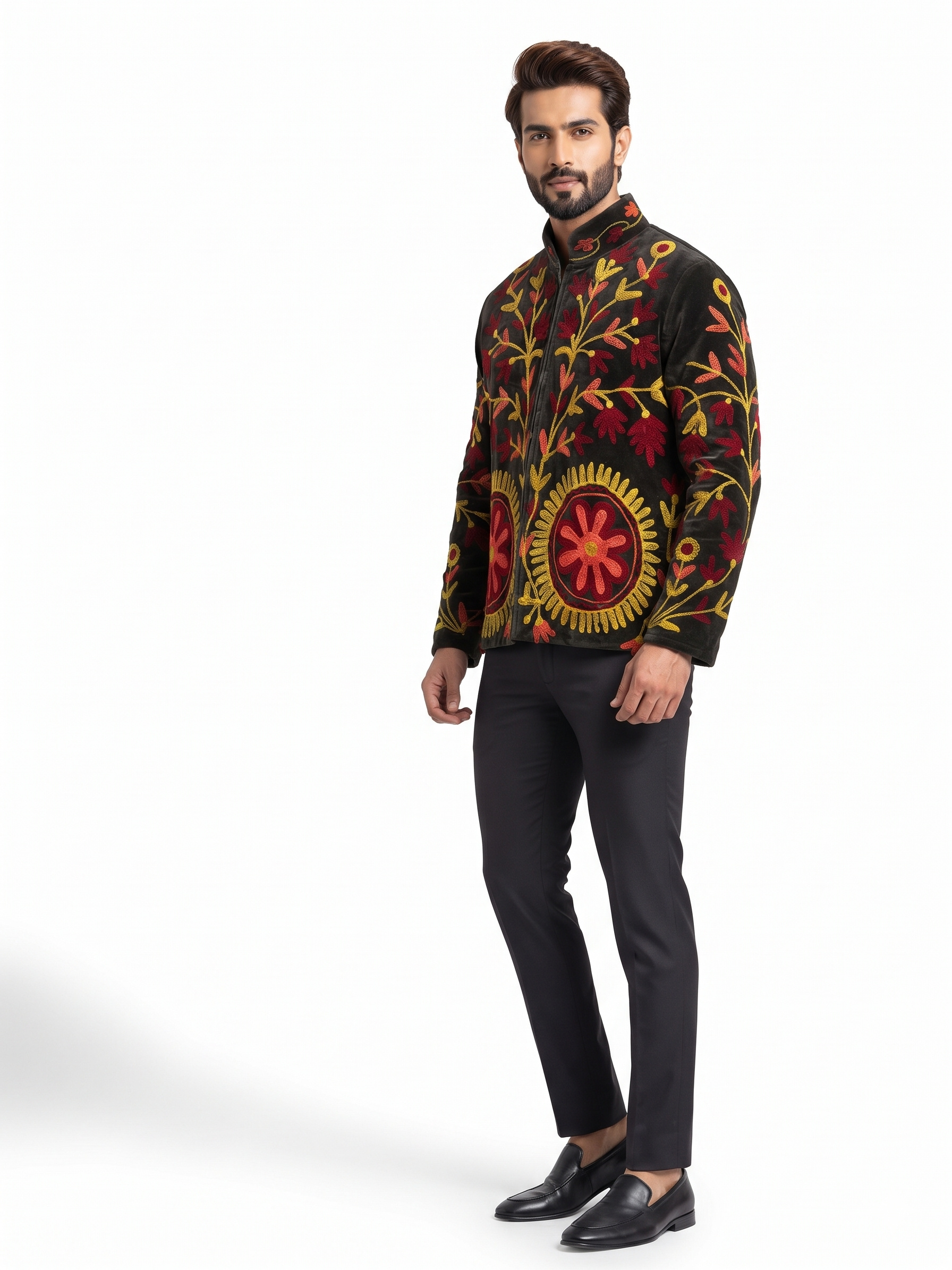
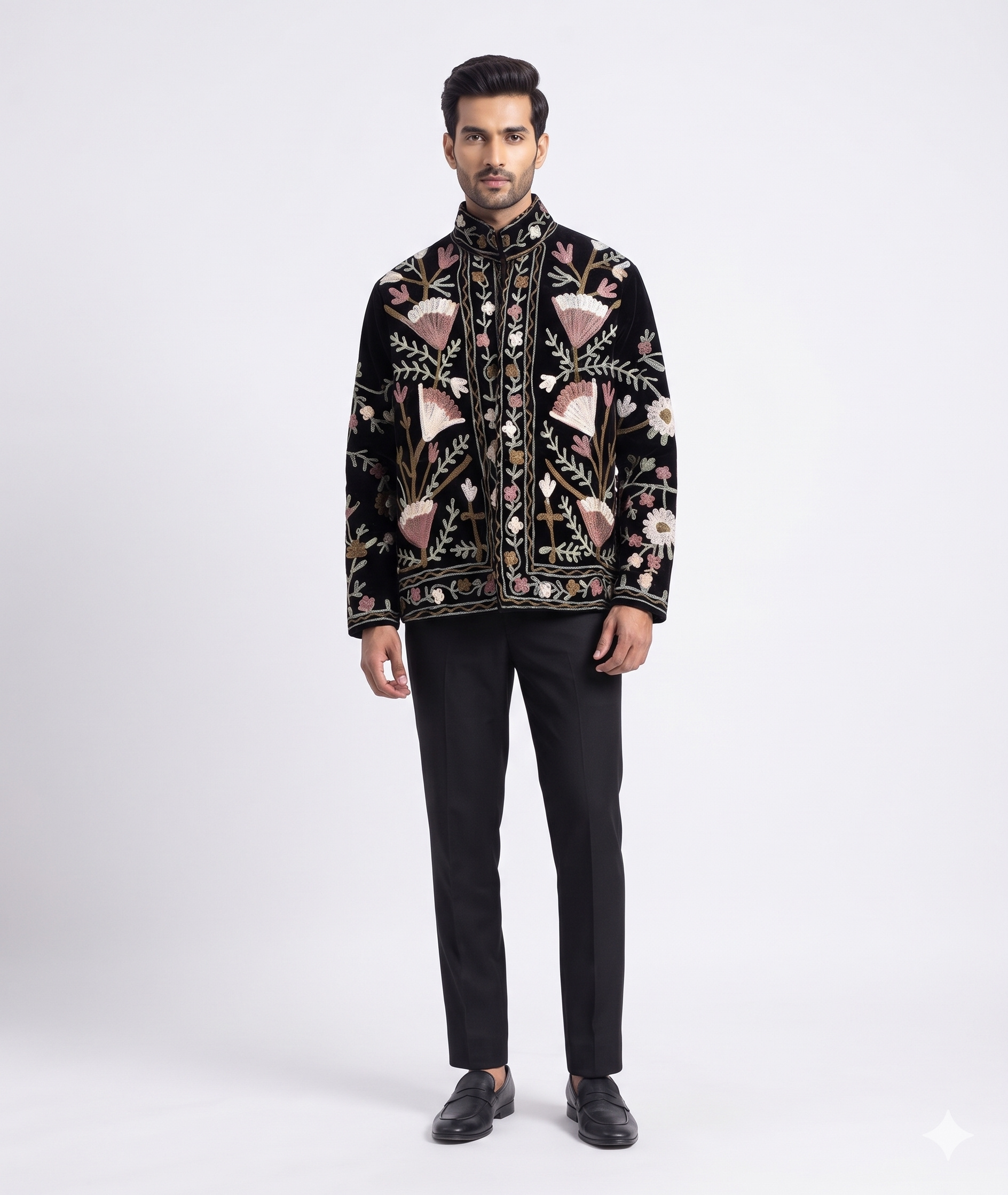
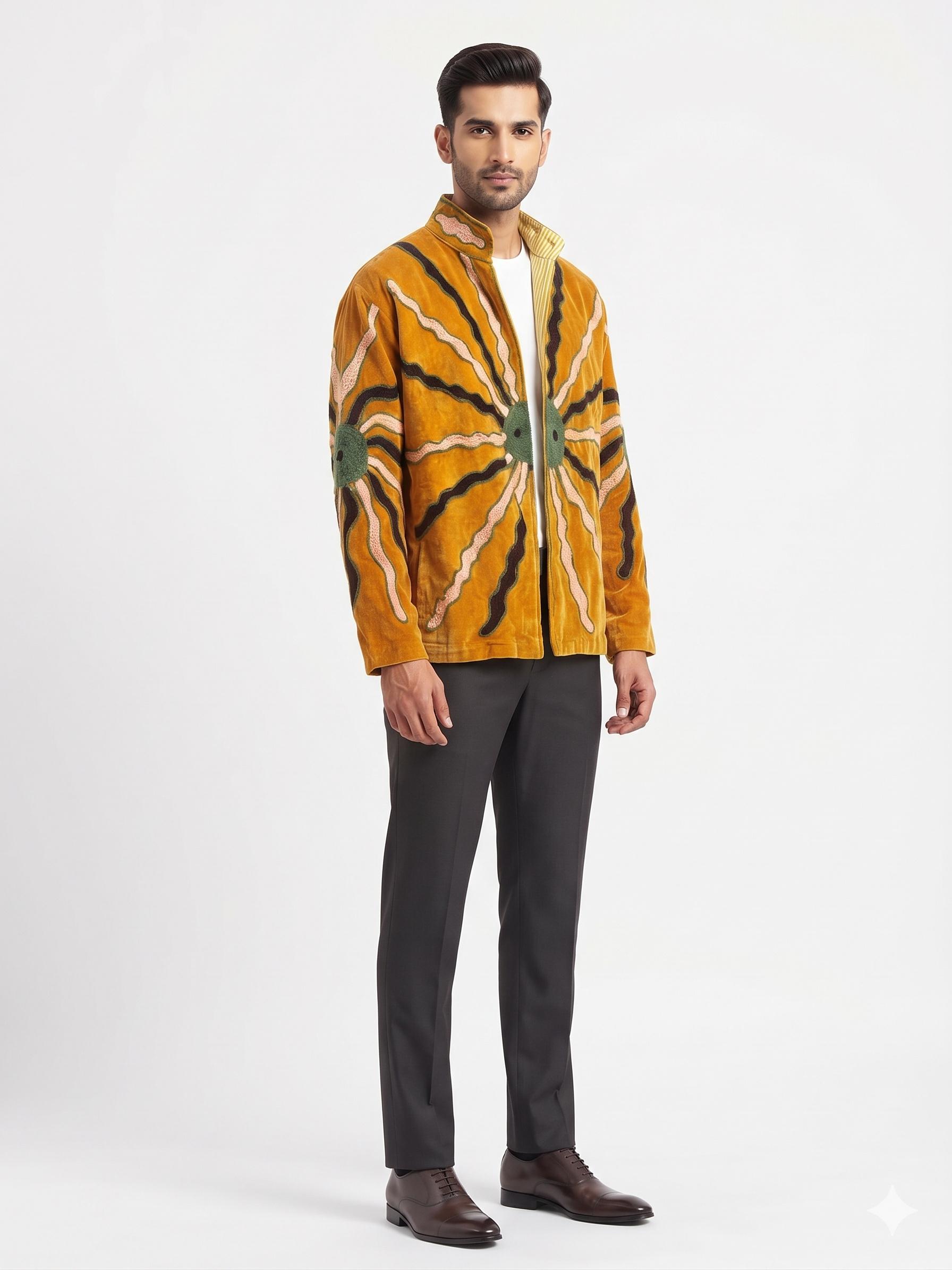
Jaipur, meanwhile, is one of India's busiest textile cities, known for hand block printing in nearby Sanganer and Bagru as well as for embroidery and tailoring. Today, Suzani-inspired work from Jaipur appears on jackets and kimonos rather than on large dowry cloths. The motifs are familiar, sunbursts, florals, vines and paisleys, but they are reworked for clothing and often mixed with Indian folk elements. That is why the same piece might be called a jaipuri jacket, a boho jacket or a suzani jacket: it sits right where the two traditions meet.
Our pieces at Saffron Vastra are Suzani-style rather than Uzbek antiques. Every piece, whether a velvet suzani jacket or a lighter cotton style, is hand embroidered and made to order in Jaipur, and designed for men and women alike. You can see the range in our Suzani stitchwork collection, and if you want to know what happens between a sketch and a finished garment, read how a hand embroidered Suzani jacket is made.
How to recognise hand embroidery
Machine embroidery has become very good, so it helps to know what to look for. No single sign is proof on its own, but together they tell a story.
- Compare matching motifs. On a hand embroidered jacket, the flowers on the left and right fronts will be close but not identical. Small differences in shape and spacing are normal.
- Follow the stitch direction. Hand embroiderers usually angle their stitches to follow the curve of a petal or leaf. Machine fills often run in straight, parallel lines across a shape regardless of its outline.
- Check the stitch length. Hand chain stitch and couching show slight variation in length and tension. Perfectly uniform stitches across a large area suggest a machine.
- Feel the thread. Machine thread tends to be tightly twisted and firm, while hand embroidery threads often feel softer.
- Look at the reverse if you can. Hand work shows irregular starts, stops and knots. Long, orderly threads carried from motif to motif, white bobbin thread or a stiff backing layer point to a machine. On a lined jacket you may only get a glimpse near a hem.
- Ask. A good seller should tell you plainly whether a piece is hand or machine embroidered.
Small irregularities are not defects. They are the signature of a person working with a needle or hook, and they mean no two jackets are exactly alike.
Shop the look
If the history has you looking at sun medallions and vines with new eyes, these pieces carry those motifs into everyday wear:
- Mustard Velvet Suzani Jacket with Sunburst Embroidery, a nod to the classic sun disc
- Red Velvet Suzani Jacket with Branching Floral Threadwork
- Taupe Velvet Embroidered Jacket with Smiling Sun Motifs
- Navy Blue Velvet Kimono Jacket with Heart and Fruit Motifs, a longer kimono jacket shape
- Sky Blue Embroidered Jacket with Folk Floral Vines
Browse all our Suzani jackets, and once you have found a favourite, our guide on caring for a velvet embroidered jacket will help it last.